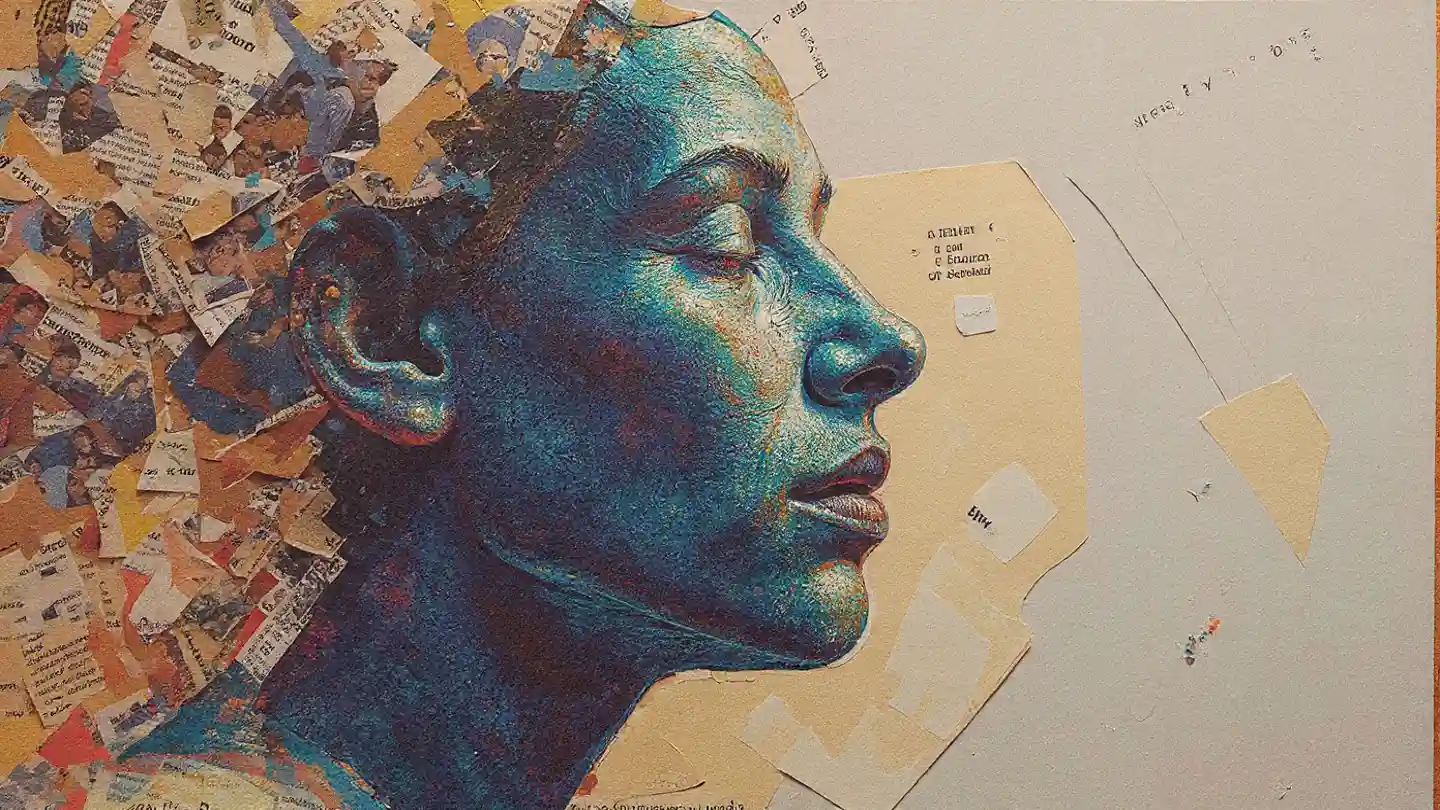
Today, I want to confront you with a question that is simultaneously strange and profound. It is a puzzle that remains unsolved by science. I repeat—no one has the answer yet. By the time you finish reading this, you might just discover a new version of yourself.
The question is: What exactly is Consciousness?
Sounds simple? Hold on a second. We usually think on a macro scale. But zoom in on yourself for a moment. What are you made of? Forget the heart, kidneys, or brain. If you go to the very limit of a microscope, you will see that you are nothing but a collection of Carbon, Hydrogen, and Nitrogen.
Go deeper. You’ll find electrons, protons, and neutrons. Current science tells us that while electrons are fundamental, protons and neutrons can be broken down into ‘quarks.’ In the future, we might even find ‘strings’ or deeper structures beneath quarks.

At the end of the day, you and I are essentially just a heap of subatomic particles.
Now, here is the real question: Does an electron have emotions? Does a proton know it is alive?
The answer is—No. These are lifeless, inert particles. They simply follow the mathematical equations of physics.
1. Where is the Paradox?
The paradox lies here: None of the components that make up you and me possess any consciousness. Yet, when billions of these unconscious particles come together to form a brain, suddenly, the sensation of “I exist” is born. How?
To solve the mystery of how consciousness arises from inert matter, scientists use a specific term: ‘Emergence.’ Let’s break down emergence simply.
Think of your smartphone or laptop screen. It is made of millions of tiny pixels. If you look at a single pixel, you won’t understand anything. It’s just a red, blue, or green dot. It has no meaning, no story, no emotion. But when millions of pixels light up together in a specific pattern, you see a movie on the screen. There is laughter, tears, and suspense.

Our brain is a massive web of pixels like that. A single neuron is not a sentient entity. They essentially communicate with each other through electrical and chemical signals—comparable to a pixel turning on or off. But when approximately 86 billion neurons fire in rhythm, memory is created, emotion is born, and consciousness emerges.
We are the universe’s movie, projected through atomic pixels.
2. Are We Just Hardware?
Here, philosophers throw a curveball at scientists. They say, “Hold on, the analogy is great, but there is a problem.” This is known as ‘The Hard Problem of Consciousness,’ a concept popularized by philosopher David Chalmers.
A computer screen shows a movie, true, but does the computer enjoy the movie? Does the computer laugh or cry? No. It merely processes data.
But when you and I watch a sunset, we don’t just process visual data. We feel a sense of wonder inside. If someone pinches your hand, it’s not just a signal traveling to a neuron; you literally feel pain. Where does this subjective experience come from inside a biological machine made of inert matter?
There is no room for these feelings in any equation of the Standard Model of physics. Why this difference exists is arguably the biggest unanswered question in modern science. This is where science hits a wall.
3. You Are Not Matter, You Are a ‘Rhythm’
Here is another fact that will make you think. Biology tells us that almost every atom in the human body is replaced every few years. New atoms enter through food, and old atoms leave.
This means the “you” from 10 years ago and the “you” of today are not the same person materially. Your physical ingredients have changed.
Yet, you are still ‘You.’ Your childhood memories, your personality—it all survives. Do you know why?
Because you are not the material; you are the pattern.
Just as an ocean wave is made of water but is not the water itself—it is the movement of the water. Similarly, you are made of atoms, but you are not the atoms. You are the specific dance or rhythm of those atoms. As long as this rhythm or pattern persists, your consciousness survives.
Let me share a poetic thought to wrap this up. The universe began with a massive explosion and lifeless gas. For billions of years, that gas burned inside the bellies of stars, creating heavy elements. Eventually, the ash of those dead stars gathered to form your brain.
Remember that famous quote by cosmologist Carl Sagan?
“We are a way for the cosmos to know itself.”
We may be made of insignificant stardust. But we are that special stardust which stood up, looked back at the cosmos, and asked—
“Who am I? Why is there a world?”
Consciousness might not be a simple property of matter. Perhaps it is the process of the universe waking up. This isn’t a scientific conclusion, but rather a philosophical interpretation. In this infinite void, our brain is the mirror where the universe gets the chance to see itself.
4. So, What is the Answer?
After all this discussion, what is the conclusion? Does science have no final answer? Or will we never find it?
The honest answer is—not yet. Science is still groping in the dark. The answer might be hidden in an unknown equation of Quantum Mechanics, or perhaps consciousness lies beyond the boundaries of current science. Once, electricity and magnetism were considered magic; today, they are in the palm of our hands. The mystery of consciousness may one day be captured in the notebook of mathematics.
But the lack of an answer is the most beautiful part of this story. If all mysteries were solved, the primal thrill of existence would vanish. The unknown keeps us curious. We are searching for answers, and this cosmic process of searching is what we call—Life.
What do you think? Is the ‘you’ who just read this article simply a game of neurons, or is there something deeper at play?
